
Choosing the right conference room table dimensions is one of the most important decisions when designing a professional meeting space. The table needs to fit the room, comfortably accommodate your team, leave enough space for chairs and movement, and support the technology used during meetings.
Whether you are furnishing a small executive meeting room, a corporate boardroom, or a large conference space, getting the dimensions right from the beginning can prevent expensive design changes later.
For businesses looking for a truly custom solution, a conference table can also be built around the exact dimensions of the room rather than forcing the room to accommodate an off-the-shelf table.
At the.Boardroom, we build custom boardroom tables and conference tables to suit the size, seating requirements, design goals, and technology needs of modern organizations. Our completed projects range from 10-foot tables to 22-foot and larger custom conference installations. Explore our custom boardroom table portfolio.
What Are the Standard Conference Room Table Dimensions?
There is no single standard conference table size because meeting rooms vary significantly in size and function. However, rectangular conference tables commonly fall into several general size categories.
For many meeting spaces, table lengths begin around 6 feet and increase in 2-foot increments as seating capacity grows. Table widths commonly range from approximately 36 to 48 inches, while larger executive and boardroom tables can be considerably wider.
A useful starting point is to consider both the number of people you need to seat and the amount of clearance required around the table.
Conference Table Size Guide
| Table Length | Approximate Seating Capacity | Typical Use |
|---|---|---|
| 6 ft | 4–6 people | Small meeting rooms |
| 8 ft | 6–8 people | Small conference rooms |
| 10 ft | 8–10 people | Executive meetings |
| 12 ft | 10–12 people | Medium boardrooms |
| 14 ft | 10–14 people | Large meeting rooms |
| 16 ft | 12–16 people | Executive boardrooms |
| 18 ft | 14–18 people | Large corporate boardrooms |
| 20 ft | 16–20 people | Large boardrooms |
| 22 ft+ | 18–24+ people | Governance and large conference spaces |
These figures are guidelines rather than rigid rules. Chair size, table width, leg placement, room layout, power requirements, and how much personal workspace each person needs can all change the ideal dimensions.
For example, a 12-foot conference table may comfortably accommodate a dozen people in one room but feel crowded in another depending on the chairs, room layout, and intended use.
How Much Space Do You Need Around a Conference Table?
One of the most common mistakes when planning a conference room is measuring only the table.
You also need to account for chairs, walking space, doors, walls, display screens, cabinets and other furniture.
A conference room table that technically fits inside a room can still make the space uncomfortable if people cannot easily move around it.
As a general planning approach, allow substantial clearance between the outside edge of the conference table and surrounding walls or furniture. Larger clearances are especially important in executive rooms where chairs are larger and people may need to move behind seated participants.
Before ordering a table, measure:
- The full length and width of the room
- Door openings and entry paths
- Windows and built-in features
- Existing furniture
- Display screens or presentation walls
- Chair dimensions
- Power and data locations
- Required walking paths
The goal is not simply to make the largest table possible. The goal is to create a room that feels comfortable, functional and proportionate.
How Many People Can Sit at a Conference Table?
Seating capacity depends on more than table length.
A common planning guideline is to allow roughly 24 to 30 inches of table space per person, although executive boardrooms may benefit from more personal space.
For example:
8-Person Conference Table
An 8-foot table can work well for smaller teams and executive meetings. A width of approximately 36 to 48 inches provides enough working surface for laptops, documents and meeting materials.
10-Person Conference Table
A 10-foot table is a popular choice for medium-sized meeting rooms. It provides more workspace while remaining practical for many corporate environments.
12-Person Conference Table
A 12-foot table can comfortably accommodate a larger leadership team and is often a strong option for executive boardrooms.
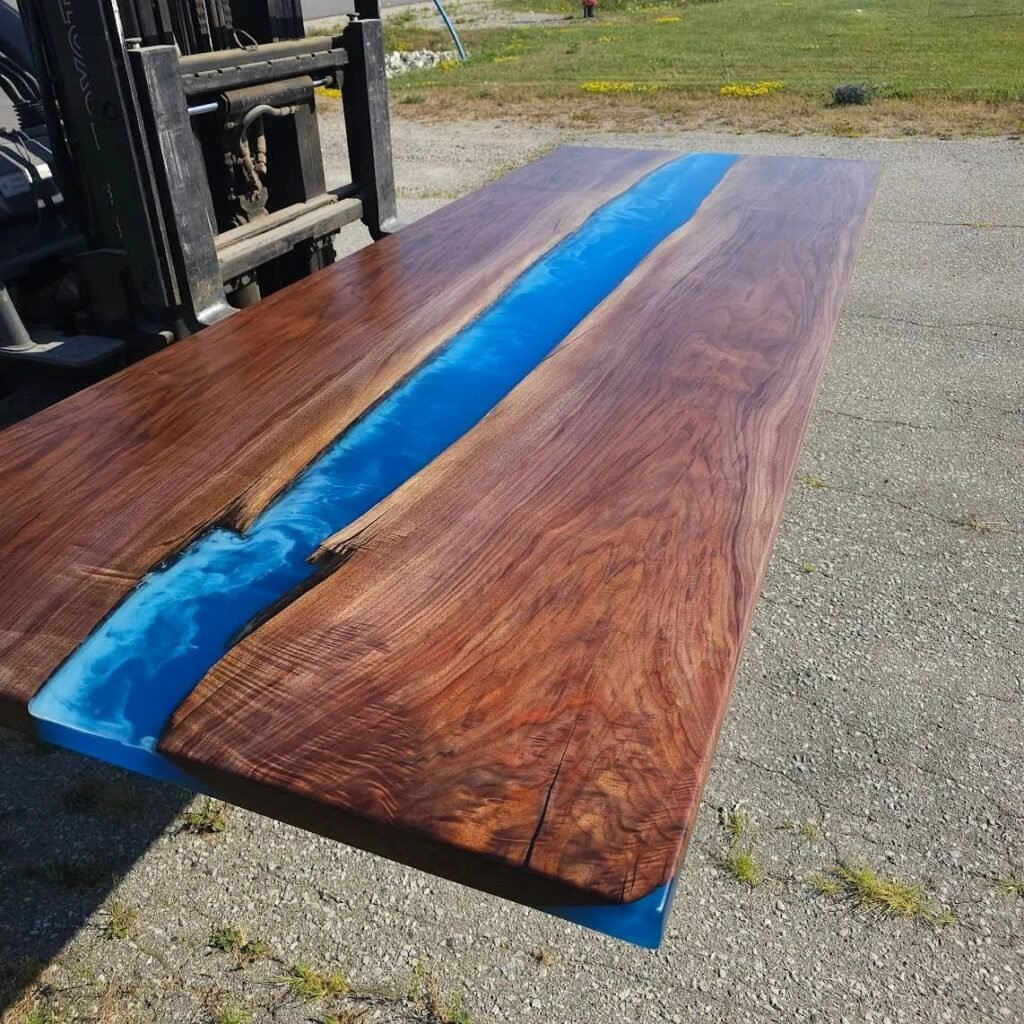
At the.Boardroom, we have built custom 12-foot black walnut epoxy river boardroom tables for clients including Polaris, Aurora Glass and 4Point Management. These projects demonstrate how a standard length can still be customized extensively in terms of width, wood selection, epoxy design and technology integration. See our completed boardroom table projects.
16- to 20-Foot Conference Tables
Large corporate boardrooms may require tables between 16 and 20 feet long.
At this size, construction, transportation, installation, slab selection and structural engineering become much more important.
A custom table can be designed around the exact room instead of relying on standard furniture dimensions.
22-Foot and Larger Boardroom Tables
Large governance rooms, corporate headquarters and institutional meeting spaces may require tables considerably larger than standard commercial furniture.
The.Boardroom has completed large-format tables including a 20-foot maple boardroom table, a 21-foot maple conference table and a 22-foot ash table designed for a large institutional setting.
What Is the Ideal Conference Table Width?
Conference table width is just as important as length.
For a typical rectangular conference room table, widths around 42 to 48 inches provide a practical balance between workspace and room clearance.
Wider tables can be beneficial in executive boardrooms because they provide more surface area for:
- Laptops
- Documents
- Presentation materials
- Conference room microphones
- Power modules
- Video conferencing equipment
However, increasing the width also increases the amount of floor space required.
For larger boardrooms, a custom-width table can make much more sense than choosing a standard-size conference table.
For example, The.Boardroom builds custom tables around room dimensions and seating requirements, with wider configurations available where the space allows.
What Is the Standard Height of a Conference Table?
A typical conference room table is approximately 29 to 30 inches high.
This height works with most standard office and conference chairs and provides a comfortable working position for meetings.
However, custom furniture allows other details to be adjusted, including:
- Table height
- Top thickness
- Edge profile
- Base design
- Leg placement
- Accessibility requirements
For a custom boardroom, these details should be considered alongside the table dimensions rather than treated as an afterthought.
Conference Table Shapes and How They Affect Dimensions
Dimensions are only part of the decision. Table shape also has a major effect on how a conference room feels and functions.
Rectangular Conference Tables
Rectangular tables are the most traditional option for corporate meeting rooms.
They work particularly well in rooms with a rectangular footprint and maximize usable seating along the long sides.
Boat-Shaped Conference Tables
Boat-shaped tables gradually widen toward the middle.
This design can create a more spacious feel and improve sightlines between participants.
Oval Conference Tables
Oval tables eliminate sharp corners and create a softer, more contemporary appearance.
They can be especially attractive in executive boardrooms where visual design is just as important as seating capacity.
Live Edge Conference Tables
Live edge tables preserve the natural edge of the hardwood slab.
This creates a more organic aesthetic and makes each table visually unique.
Live edge is especially popular with premium black walnut and maple because the natural contours and grain become part of the design.
Epoxy River Conference Tables
Epoxy river tables combine two or more hardwood slabs with a resin channel running through the centre.
The epoxy can be clear, translucent, metallic, coloured or highly customized.
This style is increasingly popular in executive boardrooms because it combines natural materials with contemporary design.
The.Boardroom offers custom epoxy river boardroom tables with options including custom resin colours, metallic pigments, textured effects, logos, inserts and different table shapes.
How to Choose the Right Conference Table for Your Room
Before ordering a conference table, answer five important questions.
1. How many people need to sit at the table?
Start with your current team, but think about future growth as well.
A table that seats eight today may quickly become inadequate if your organization expects to expand.
2. How large is the room?
Measure the room before selecting the table.
Do not forget to account for doors, walls, display screens, cabinets and walking space.
3. What will the table be used for?
A table used primarily for executive discussions may have different requirements than a large training or governance table.
Consider whether people will need laptops, documents, presentation materials or video conferencing equipment.
4. Does the table need integrated technology?
Modern boardrooms frequently require built-in power and connectivity.
Depending on your requirements, a custom table can incorporate:
- Electrical outlets
- USB charging
- Data connections
- Cable management
- Conference equipment
- Monitor connections
- Custom power modules
The.Boardroom specifically offers integrated power solutions and cable management as part of its custom boardroom table designs.
5. What impression should the room create?
A conference room is often one of the first places clients, investors, partners and prospective employees experience your company.
The table can become a major part of the room’s identity.
A clean maple table may create a bright architectural appearance. Black walnut can provide a darker, more executive aesthetic. A live edge design can introduce natural character, while an epoxy river table can become the room’s visual focal point.
Why Choose a Custom Conference Table?
Off-the-shelf conference tables are designed around general dimensions.
Custom tables are designed around your requirements.
That difference becomes increasingly important when you have an unusual room, a large seating requirement, a specific wood species, technology integration needs or a particular design vision.
A custom conference table can be built around:
- Exact room dimensions
- Specific seating capacity
- Custom width
- Preferred wood species
- Live edge or straight edge
- Epoxy river design
- Custom colours
- Company logos
- Integrated power
- Custom bases
- Special finishes
At the.Boardroom, every table is made to order, allowing the design to be developed around the client, the room and the intended use.
Black Walnut vs. Maple for a Conference Table
Wood selection can completely change the character of a boardroom.
Black Walnut
Black walnut is a popular choice for executive boardrooms because of its rich colour, dramatic grain and premium appearance.
It works particularly well for luxury live edge tables and epoxy river conference tables.
Maple
Maple provides a lighter and cleaner appearance.
Its bright colour and relatively consistent grain make it well suited for modern offices, institutional spaces and contemporary boardrooms.
The.Boardroom has completed large maple conference tables including 20-foot and 21-foot projects.
White Ash
White ash provides strong grain character with a lighter overall appearance.
It can be particularly effective for very large custom conference tables where the natural grain becomes part of the room’s architectural design.
How Much Does a Custom Conference Table Cost?
Custom conference table pricing varies significantly depending on size, wood species, construction, finish and additional features.
A smaller custom hardwood table may cost several thousand dollars, while large executive boardroom tables with premium slabs, epoxy work and integrated technology can reach substantially higher price points.
The.Boardroom currently reports custom boardroom table projects ranging from approximately $4,000–$6,000 for smaller tables to $25,000–$40,000+ for large premium configurations, with many 10- to 16-foot projects falling in the $8,000–$20,000 range.
Epoxy designs can also affect the final cost depending on resin volume, pigments, layering, colour matching and special effects.
For a more detailed breakdown, read our guide: How Much Does a Custom Boardroom Table Cost in Canada?.
Conference Table Dimensions FAQ
What size conference table do I need for 8 people?
An 8-foot conference table is a common starting point for eight people, although the ideal size depends on chair dimensions, the desired personal workspace and the shape of the table.
What size conference table do I need for 10 people?
A 10-foot table is a common starting point for approximately ten people. A larger table may be preferable when meetings involve laptops, documents and other equipment.
What size conference table do I need for 12 people?
A 12-foot conference table can work well for approximately twelve people, although wider configurations may provide greater comfort in an executive environment.
How wide should a conference room table be?
Approximately 42 to 48 inches is a practical range for many rectangular conference tables. Larger rooms may allow for wider executive tables.
How much space should be around a conference table?
The table needs enough surrounding clearance for chairs and comfortable movement. Room layout, door locations and other furniture should all be considered before finalizing the table dimensions.
Are custom conference tables worth it?
For businesses with a specific room layout, large seating requirements, premium design expectations or technology integration needs, a custom table can provide significantly greater flexibility than an off-the-shelf option.
What is the best wood for a boardroom table?
There is no single best species. Black walnut is popular for luxury executive rooms, maple provides a lighter contemporary appearance, and white ash offers distinctive grain and a versatile architectural look.
Final Thoughts: Get the Dimensions Right Before You Build
The right conference room table dimensions can completely change how a meeting room functions.
The best table is not necessarily the largest one that will fit through the door. It is the table that provides the right balance of seating, workspace, movement, technology and visual impact for the room.
For smaller meeting rooms, an 8- to 10-foot table may be ideal. Medium boardrooms often benefit from 10- to 14-foot tables, while larger corporate and institutional spaces may require 16-, 18-, 20- or even 22-foot custom tables.
When the room or requirements fall outside standard furniture dimensions, custom design becomes especially valuable.
At the.Boardroom, we build custom conference tables and boardroom tables throughout Canada and North America using premium hardwoods including black walnut, maple and white ash, along with live edge construction and custom epoxy river designs.
Browse our Custom Boardroom Table Portfolio to see completed projects, or request a free quote for a table designed around your room, seating requirements and vision.