
Choosing a boardroom table isn’t like picking out a desk chair. It’s the piece of furniture that sits at the center of every major decision your company makes — the thing clients see first when they walk into your office, and the thing your leadership team stares at during every negotiation, review, and all-hands meeting. So it’s worth getting right.
The problem is that most people start their search with a blank idea of what “custom” even means. Custom compared to what? Custom in what wood? What shape? What finish?
The fastest way to answer those questions isn’t to stare at a blank design brief — it’s to look at tables that have already been built for companies like yours. Below are seven design directions pulled straight from completed boardroom and conference table projects, along with what makes each one work.
Why Start With a Portfolio, Not a Blank Page
A custom boardroom table portfolio does more than show off finished furniture. It tells you what’s actually possible: real dimensions for real rooms, real wood species that held up over time, and real finishing choices made by other businesses solving the same problem you are. Instead of guessing at specs, you can point to a project and say “something like that, but our size” — which makes the entire quoting process faster and more accurate.
With that in mind, here are seven proven directions to consider for your own build.
1. Large-Format Solid Wood for Institutional Boardrooms
When a table needs to seat a large group — a full leadership team, a board of directors, or a governance assembly — solid hardwood slabs in maple or white ash tend to outperform anything laminate or veneer can offer. A 20-foot solid maple table built for Canadore College and a 22-foot white ash conference table built for ETFO (the Elementary Teachers’ Federation of Ontario) both prove the point: at these sizes, the table stops being a piece of furniture and becomes a defining feature of the room itself.
Best for: Institutions, associations, unions, and companies with large executive teams who need a formal, durable table that seats 12–20+ people.
2. Black Walnut Epoxy River Tables for Executive Statement Pieces
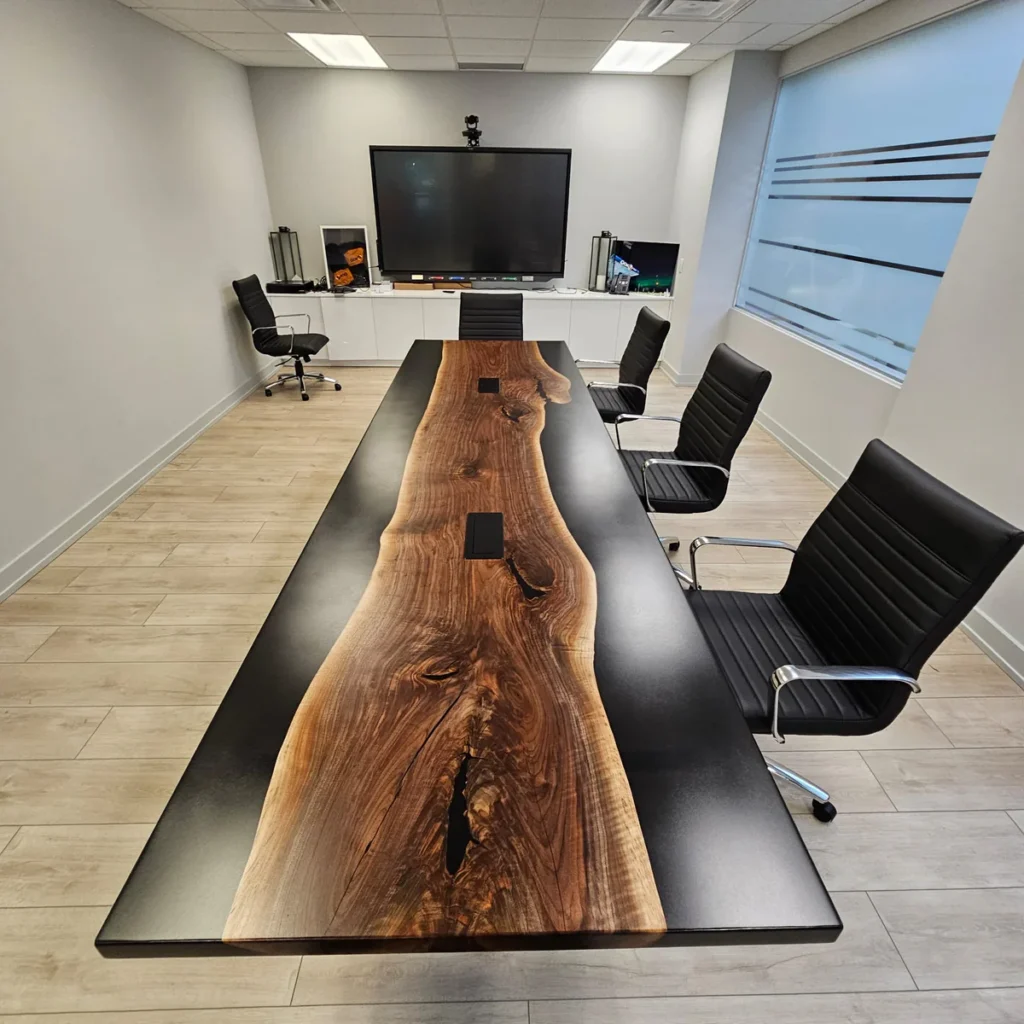
If your boardroom needs to make an impression the moment someone walks in, a black walnut epoxy river conference table is one of the most requested designs for a reason. Black walnut brings a rich, dark grain that reads as authority and warmth at the same time, and an epoxy river running through the center — clear, semi-transparent, or solid black — turns a functional table into a genuine centerpiece. This is the exact approach used in executive builds for Polaris Food Company, Aurora Glass, and 4Point Management.
Best for: Executive boardrooms, client-facing meeting rooms, and any company that wants their table to double as a design statement.
3. Logo and Branding Built Into the Epoxy Pour
One design detail that consistently sets a corporate boardroom table apart: embedding the company logo directly into the epoxy river. Rather than relying on wall signage or a printed placard, the branding becomes a permanent part of the table itself — visible in every meeting, every video call, and every photo taken in the room. Epoxy color can also be matched to your brand palette, so the table reinforces your identity instead of just sitting in the room.
Best for: Companies that want the boardroom table to reinforce brand identity, not just provide a work surface.
4. Live Edge for a More Organic, Natural Feel
Not every boardroom needs sharp, uniform lines. Leaving the natural live edge of the slab intact — rather than milling it perfectly straight — gives a table a more organic, high-end feel that pairs especially well with modern or biophilic office design. Live edge boardroom tables tend to work best when the surrounding space already leans toward natural materials: exposed wood, stone, or greenery.
Best for: Design-forward offices, creative agencies, and boardrooms that want to soften a formal setting with natural texture.
5. Exotic Species for a One-of-a-Kind Statement
For companies that want a table no competitor could ever replicate, exotic species like spalted maple and burl slabs are worth a serious look. Spalting creates dramatic, unpredictable black line patterns through the grain, and burl slabs carry dense, swirling figure that makes every table genuinely one-of-a-kind — no two builds ever look the same. Paired with a matte black or metallic mica epoxy pour, these species turn a conference table into a piece of functional art.
Best for: Executive suites, private offices, and boardrooms where visual impact is the top priority.
6. Matching the Shape to the Room
Custom doesn’t just mean wood and finish — shape matters just as much. Rectangular remains the standard for larger boardrooms, but round and oval tables are worth considering for smaller executive rooms where equal sightlines matter, since they remove the “head of the table” hierarchy that a rectangular shape naturally creates. The right call usually comes down to room dimensions, seating count, and how formal you want the meeting dynamic to feel.
Best for: Any boardroom — this is often the first decision to make before choosing wood species or epoxy style.
7. Integrated Power Ports and Cable Management
The best-looking boardroom table in the world still fails if everyone’s laptop charger is duct-taped to the floor. Built-in power ports, USB charging, and hidden cable routing are now standard requests on most custom conference table projects, and they’re far easier to plan for at the build stage than to retrofit later. If this is a priority for your team, it’s worth reviewing the full list of customization options before finalizing your design.
Best for: Any boardroom that regularly hosts video calls, presentations, or laptop-heavy meetings.
Turning Inspiration Into Your Own Custom Boardroom Table
Once you’ve found a direction that fits — whether that’s a black walnut epoxy river table, a large-format maple build, or a live edge statement piece — the next steps are straightforward:
- Browse the full project portfolio to find a build closest to your vision, including dimensions and finish details.
- Review wood species to narrow down grain, tone, and durability for your space.
- Request a quote with your rough dimensions, seating count, and any must-have features like power ports or a logo insert.
- Refine the design with a specialist based on your room, budget, and timeline.
Every table is built to order, so there’s no pressure to fit your requirements into an existing product listing — the portfolio exists to spark ideas, not limit them.
Frequently Asked Questions
How much does a custom boardroom table cost? Pricing depends on size, wood species, and finish complexity. For a full breakdown, see how much a custom boardroom table costs in Canada.
How long does it take to build one? Timelines vary by size and design complexity — see the full production timeline for a realistic estimate.
What’s the difference between an epoxy river table and a solid slab table? An epoxy river table uses a resin pour to fill the natural gap between live-edge slabs, while a solid slab table is milled from a single continuous piece. Learn more about epoxy river boardroom tables to see which suits your space.
Ready to Design Yours?
The best way to start is still the simplest one: browse the custom boardroom table portfolio, find a build that speaks to you, and request a free quote with your dimensions and must-haves. Every table on that page started as exactly that — an idea someone brought to us before it became the centerpiece of their boardroom.